Armor penetration and an enemy part’s armor affect whether a hit gets through, but a weapon’s displayed damage is not a promise of the health removed by every shot. Use dated patch evidence, the actual weapon and the specific target part rather than a universal enemy table.
The old 50% partial-damage rule is outdated
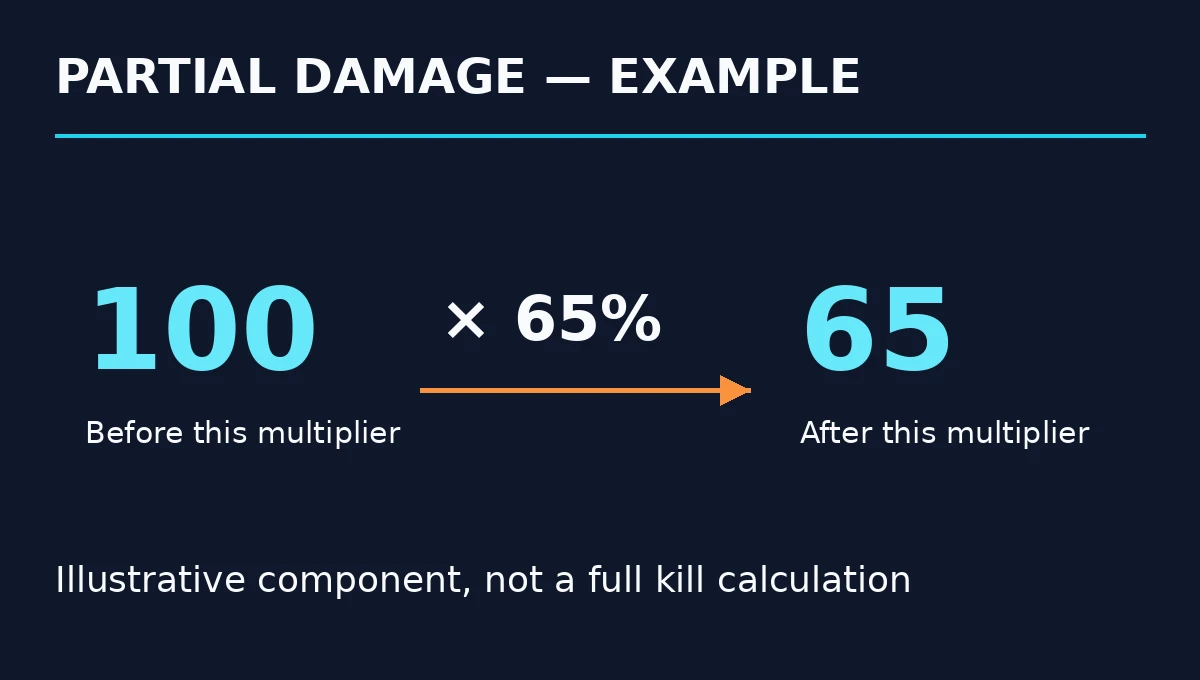
Arrowhead’s Patch 1.001.100, released in September 2024, explicitly raised partial damage from 50% to 65% of full damage. Our previous table still used 50%. That dated change is confirmed; this article does not claim that it is a complete damage formula for every current weapon, attack and target.
| Question | What the source establishes |
|---|---|
| Was partial damage previously 50%? | Yes, the September 2024 notes describe the previous value. |
| What did that update change it to? | 65% of full damage. |
| Does that alone establish a kill count? | No. The weapon, target part, health and other mechanics still matter. |
A small calculation, not a kill prediction
If an illustrative damage component were 100 before a 65% partial-damage multiplier, it would become 65. At 50%, it would become 50: a difference of 15 in this isolated calculation. This does not say that a named weapon does 65 damage to a named enemy, and it does not include all damage stages or rounding.
Do not turn that number directly into shots-to-kill without a validated target health, target-part model and attack. Explosive, projectile and other components should not be assumed to behave as one identical hit.
Why impact angle and projectile type matter
Arrowhead’s Patch 01.003.000 in May 2025 changed shrapnel penetration at certain angles for the Eruptor, Frag Grenade and Autocannon. This is concrete evidence that a broad label such as “medium penetration” does not capture every projectile and angle-dependent interaction.
Keep the distinction between a weapon’s main attack and additional effects in your notes. A change to shrapnel is not proof that every attack fired by that weapon changed in the same way.
A troubleshooting sequence for an ineffective hit
- Record the exact weapon and fire mode, plus the version you are playing.
- Identify the enemy and body part you aimed at. Do not label the entire enemy with one armor value from an old chart.
- Note range, angle and visible feedback. A hit effect alone is not a measurement of exact damage.
- Try a different exposed part or an appropriate alternative weapon while keeping the rest of the comparison as consistent as possible.
- Read patch notes for that weapon and enemy before blaming aim or declaring the equipment broken.
How to record a comparison without claiming universal results
| Record | Why |
|---|---|
| Game version, weapon and attack | Allows later balance changes to be identified. |
| Enemy, target part and initial condition | A previously damaged target is not a fresh one. |
| Distance, angle and shots | Prevents different setups being treated as equivalent. |
| Other players, damage effects or interruptions | Identifies observations that cannot isolate your attack. |
This is a suggested observation method. We have not used it to publish new measurements here. Without repeatable tests, do not advertise an “instant kill”, a fixed durable percentage or a universal ricochet angle.
Use the result in a loadout
Choose a way to deal with the threats your current mission presents, rather than assuming the highest displayed damage covers all target types. The stratagem guide and faction guides should be read with the same version and evidence checks. A ranking from a different patch is not a substitute for the current weapon’s behavior.
Published by Helldivers Catalog Expansion. Source review: 11 October 2026. The practical worksheets are editorial suggestions, not a report of controlled gameplay testing.